Saturday, November 12, 2011

Remembering My Grandfather through his pictures of the war - A VeteransDay Reflection

This Veterans' Day I took some time to think about the Vets that I know.  The close, high school friend who has served in Iraq and will be going to Afghanistan.  The former student who welled up with pride as he told me that working on an aircraft carrier made him into a man.  My father, who served as a Chaplain in both the navy reserves and the army national guard.  My great uncle, who was shot down and spent years in a POW camp.  My other great uncle, who served on a PT boat and met JFK.  My dad's father, who was in the navy and worked in the office of a high ranking officer.  And my mother's father, who served in Patton's army as an army engineer.

I have not served.  I am one of the majority of US Americans whose life has been touched by veterans, but who has not worn the uniform.  I had seriously considered joining the military in high school, but decided not to.  I won't speculate how my life would now be different if I had done so.  Today, I am opposed to the unnecessary use of military force.  However, I acknowledge that reasonable people can disagree on what constitutes a "necessary" use of force, and I have a serious respect for those who do serve in uniform.  I think that this respect comes from knowing of the soldiers among my own friends and family.

I remember as a child asking my dad if he got to shoot a gun.  He replied that as a chaplain, he just had to throw the bible at the enemy.  I remember that the times he was away on his two week annual trainings that I missed him - and that was only two weeks!  I can't imagine the longing to see your loved ones when they are deployed and gone for months or years at a time.  My dad was away when my youngest brother was born.  It was fortunate timing that he was able to return for a brief time to see my mom and new baby brother in the hospital.  Many soldiers do not have this chance.

I can imagine my grandfather Roger in Europe.  I never knew him, he died when I was an infant.  But I have had the chance to look through photos he took as well as the photos and postcards he collected as he traveled in Europe and Japan.  As I have looked through, organized and done background research on these photographs, I have tried to imagine being there with him.


Thanksgiving 1943, standing in front of a house in uniform with his wife Evelyn, brother Marty (also in uniform), and sister in law Jane.  He went to train at Camp Ellis in Illinois and shipped off to Europe via Camp Myles Standish in Massachusetts in early 1944.

I imagine him flying over the English countryside in a B-17 bomber (and wonder how an army GI had the chance to ride along in one to begin with).  His son Joe grew up to be a pilot.


He traveled across the English Channel to France and landed at Omaha Beach on July 24, 1944 and made the push through France that Fall. 
He was in Luxembourg during the battle of the Bulge.  By March 1945, they were in Germany.


As part of an engineering battalion he helped to rebuild bridges bombed out either by the Allies while they were in Nazi hands, or destroyed by the Nazis as they retreated.


There are a lot of pictures of these bridges:
bridges over the Marne and the Meuse in France;
a bridge over the Sauer river between Luxembourg and Germany; and a bridge over the Rhine at Mainz, Germany.
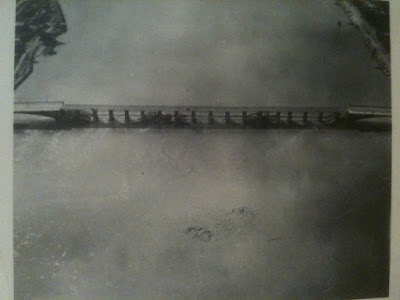


Written in pencil on the back of some of these photos are his descriptions, effusing pride, of the bridges that his battalion rebuilt ("The longest, highest, widest military built bridge in the world across the Rhine at Mainz - 17 days!").
Other pictures and their penciled descriptions give glimpses of scenes of his life in France, Luxembourg, and Germany in 1944 and 1945.


He took pictures of a French Military Barracks where they stayed for three weeks;
...a group of soldiers standing around a meal truck - "hot coffee, doughnuts and rain" (and I bet that it never tasted so good);

"Remich on the Sauer River - just resting"; 

and "Luxembourg near the border - real champagne - beaucoup cases!"

     There are pictures of cathedrals, castles, villages,


German POWs ("Jerry Prisoners" and "sad sacks"), "new kraut equipment" and a half built stadium in Germany.


There are also some pictures that need no description: GIs with French women; a leggy USO performer, bombed out train yards, damaged tanks, and crumbled buildings.


But the pictures that seem most poignant are those shots of him with friends.  While many photos of random bridges and French buildings were un-labeled, the photos of him and his buddies were almost always labeled with the names of his friends:  at left "McNeil, Hurston, and Marks."  And on another picture: "Me and Charlie Pickens".


By May 1945, Germany had surrendered and he was in Nurnberg.  


In June his battalion traveled to Marseille, France where he boarded the US General John Pope and sailed through the Mediterranean,
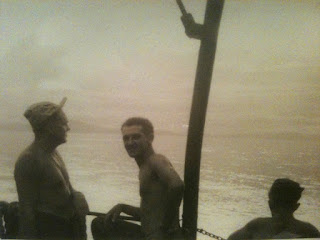

across the Atlantic,

through the Panama Canal and across the Pacific,

landing on the Marshall Islands,

and finally in Manila on August 1st.


Up to that point in time, he and his fellow soldiers must have been concerned because they thought they were on their way to join in the planned invasion of Japan.



They did not know in those middle days of summer 1945, as we now do, that within days the US would drop two atom bombs on Japan, ending the war.


So on September 15 when he arrived in Tokyo, he set foot on the soil of a Japan-surrendered.


He spent two weeks in Japan
Roger Hurston, with the Japanese Imperial Art Gallery in the Background

  On September 29 he boarded the USS Kenton
 
 
and sailed east to San Francisco, where he arrived on October 10.  

  (notice the "welcome home" banner)

He traveled to Texas where he was discharged on October 21st, and he was home in Baton Rouge by October 23, 1945.  Just short of two years from when he was preparing to ship out, he arrived home, alive and "in one piece."

But his pictures, his hand written notes, documenting dates and places, and his collected postcards and other "found" photos only tell part of the story.  My Mom has told me about the emotional damage he suffered: today, we would probably say that he had had post traumatic stress disorder.
 

I like to look at his photos and imagine the moments of camaraderie when he took those pictures with his buddies; the excitement, the scenery and the experiences of traveling across the world and two oceans.


But I also remember those things that are not captured in the photographs: the hardships shared in common by so many soldiers and what they sacrifice in service to their country.


* I assembled this timeline from a list my Grandfather had written of the dates and places where he had been in addition to the notations on the back of his photos.  There may be some minor errors - but I think I got things mostly correct!


Sunday, October 16, 2011

The car I love

I want a new car
but 
I love my old car

what kind of 
bad-ass car 
is this that 
calls for 
a song of praise?

It's not my first car
not my sexiest car
not even my most bad-ass car

Just a plain
four door
economy car
that gets good 
gas mileage
and has a decent
stereo

A car
that has driven me
across the state
and
took us on our
honeymoon
and has carried me
to and from 
work
and
university

In fact 
that same car 
carried us 
to and from 
the hospital 
when our 
oldest daughter 
was 
born

And 
when my wife 
was in the 
hospital
on bed rest 
with our second baby
that car 
carried me 
to and from 
work 
and university
and to the hospital 
to see her

(stereo blasting
to drown out
the emotion)

And when 
second baby girl 
was in the 
Neonatal 
Intensive 
Care 
Unit
(alive and always improving)
that car took 
me to see 
her 
too

Since then
it has been to 
law school
and
on family vacations
and 
I wonder
how long
it will
last

I'd like to give it a proper 
redneck memorial

Its very own 
place 
in the front yard 
where I can 
take the wheels off

and
put it
up on blocks
and drain the fluids
and remove the battery
and roll down the windows
and let nature take its course
with it always there 
as a reminder
of where
I've 
been

Wednesday, February 23, 2011

On vocations, occupations and a new vision

Today I turn 29.  My last year as a twenty-something.  I don't feel like I have been out of college for 7 years, out of high school for 11, and one year away from thirty.  But, I am.  I also did not think that a statistic, which I first heard shortly after graduating from college, would apply to me: that most new graduates my age would change careers several times in their lifetime.


My senior year of High School, I received a rejection letter from Western Michigan University’s Theatre program.  A fan of History, I had rationalized that, were I to not be accepted into theatre, I would be a history teacher.  My grandfather was a teacher, my father and many other family patriarchs had been ministers.  Teaching was as close to a family business as was to be had for a young, green Morton with his future ahead of him.  


Four years later I sat in the office of Romulus High School’s principal with a fellow student-teacher.  We were asked why we wanted to be teachers.  My fellow future teacher replied with a lovely narrative of her family’s furniture auction business, and how with each new lot of furniture, they sift through it and clean it up in preparation of the day they hand it off to the new owners.  She said that it reminded her a lot of what we do as teachers.  We receive students as they are, in what ever state they are at the time they breeze through our door.  It is our job to do what we can to prepare our charges for the time when we pass them along to the next set of hands to do with them what they can. 

The Principal turned to me and I, with my idealism on my sleeve, said that I believed that education had a transformative and liberating power.  That for our students, most of whom are classified in educationese as “at risk” (read: lower socioeconomic bracket and ethnically diverse), education is a way of opening their eyes to the challenges and opportunities our country holds for them and to empower them with the knowledge they need to take on the challenges in order to seize their opportunities.  Or something like that….
            
The Principal gave me a look that I did not fully understand until more recently.  At the time, it appeared to me to be a disapproving look.  Thinking of it now I know that he saw my idealism, and knowing what he did about education, knew that I was in for somewhat of a rude awakening.  He asked if we wanted to teach at an “at risk” school and we both enthusiastically replied affirmatively. 
            
“Why?”
            
Our responses were similar.  We liked the challenge of working with students for whom college was not a definite possibility and who we could motivate and whose lives we could have an impact. 
            
About two years later I was driving to work., a school at which I had gained employment after a few months of substitute teaching in the suburbs.  This school was exactly what I had hoped for when I was a green, idealistic education student.  It served predominantly “at-risk” students from Detroit, while still being relatively safe and organized.  And yet when I got into my car that cold, bleak midwinter morning, I was asking God why I was miserable, teaching at this school with no hope of a cozy suburban school job.  I was a mile away from my school, driving down a deserted Detroit street, lined with abandoned buildings and industrial complexes when a thought was placed on my mind – I was given exactly what had I asked for. 
            
What I did not know back when I was still an idealistic education student, hoping for a challenging inner-city job at which I could touch lives, was that the reality of education does not quite allow for that type of life touching.  Do not misunderstand me – I believe that education is a very important profession and as an educator you can have an important impact in the lives of your students.  Primarily this is by educating them according to the subject you teach, but on a personal level, by providing a safe environment where the kids in your charge should be free from many of the pressures they experience outside of school and where they are encouraged to grow intellectually.  But I had visions of larger social transformation and justice that are only seen in the occasional remarkable high school, though most often in the movies.  The type of transformative action I secretly hoped to spur is just not possible in a profession where your roles are very clearly and narrowly defined, your time with any given student is short, your influence over their opinions (teenagers are rarely influenced more than superficially by the adults in their lives and most often by their social groups, cultural influences and home life) is minimal and your time is overwhelmed by the State’s expectations of what content needs to be covered by June. 

I do believe that I have left an impression in the lives of many of my students.  I have been present in a few students’ lives when they were going through very personal struggles and have had the opportunity to provide what support I was able within the boundaries expected of teachers.  I know from the way my former students still smile at me in the hall and say hello, by the number of students that speak to me on a personal level to talk about interests, make jokes and ask/share opinions that I will be one of those teachers they may remember into adulthood: maybe as the nice teacher, or funny teacher, and maybe (if I may be so bold) the favorite teacher for a few.  I try to challenge certain misconceptions about life, stereotypes, the past and origins of various things and I believe that that has also left an impression.  And by the end of my second year I was content with that.


In my third year as a teacher, I began to wonder.  In that year I became part of a curriculum committee.  We were responsible for leading the effort to document and normalize the information about what was being taught at every level in our school and ensure that it aligned with the state’s standards.  By the end of the year our committee had expanded to include school improvement as well.  The end of that school year was also when Molly’s hospitalization occurred and our second daughter was born. 


Seeing the behind the scenes work of the educational profession and tackling head-on what is expected of us as teachers, both in terms of ever increasing documentation, credentialing, and the breadth of what content and skills we are expected to impart made me begin to wonder if I would be able to tolerate a future in education.  It also reawakened my forgotten idealism and desire to have a deeper impact in a few individuals’ lives as opposed to a little impact in a lot of lives.  I began to feel a nagging desire to have a different role in helping people.  


I also had the "good fortune" of seeing several older, burnt out teachers in action.  So close to retirement, yet not close enough. I feared that had I continued doing something that was not the right choice for me, I would become that old burnt out teacher (I think of those cliche-but true sayings, such as: if you love what you are doing you will never "work" a day in your life). 


Moreover, the financial strain of having the focal point of our lives shifted to the hospital and my wife no longer working AND the costs of a second child (who at the time consumed two $15 canisters of formula a week) revealed to me the fact that my income was not quite high enough.  This would have only been compounded by student loan payments that would begin when my Master's degree was completed (oh, yeah, and my school does not give any pay increase once you have completed a graduate degree - real incentive there).  My wife put it best: I did not go into teaching to get rich, but I also didn't get into teaching to go bankrupt either.    
            
Molly was the first to suggest I go into law.  My mom had always said I should be a lawyer, politician or criminal or some combination of the three.  My dad said that he thought it was a great idea.  I had considered being a lawyer for a while in high school before I dismissed it as too expensive and unrealistic of a career path for me.  But now, it just seemed right.  Or was it?  


I had some doubts at first: not about going into Law, but about leaving education.  Had my years as a teacher been for nothing?  My Father imparted some wisdom on me about that.  He said that changing careers does not take away what good I did as a teacher.  I was a teacher, and I would be a lawyer and I was going to be great at that too.    


The farther along this path I have traveled, the more confident I have felt that I am indeed on the right path and that I am fulfilling a vision that God gave me many years ago.  While there were things about the education classes I never liked, and the teaching profession that did not sit well with me, Law has just felt like an all around better "fit."  And it was not a hasty decision.


I spent a half-year exploring the possibility of going to law school.  Another of my early doubts was whether I would enjoy doing the work of a lawyer.  This was fueled by my lack of understanding about the wide array of legal fields and legal areas that exist.  The more that I learned about the different types of law there were and the different things I could do, the more excited I became.  Not only does it involve research (something I have always enjoyed), but so much of law involves problem solving and it gives me the chance to directly help people (not all areas of law are focused narrowly on helping people, so much as helping "people" but I am confident I will find work where I can do good).    


In 2008 I took the Law school entrance exam, the LSAT, twice to get the score I wanted.  I was accepted, got a scholarship, made it through first semester.  I have continued working full time, attending Law school part time, and have completed half of my coursework.  All the while I have been a successful law student.  I love what I am doing and I am excited about becoming a lawyer - and I admit that I was never as excited about teaching when I was in college.  


Ironically, I believe this experience has actually made me a better teacher for my students.  I realized at the start of the school year in 2009 that if I was to continue teaching while going to law school, I had to make the best of that time.  And since I have no longer been held down by the dread of spending the rest of my life in a job that is not right for me, I actually go into most school days with a positive outlook and a friendly demeanor.  I make sure to enjoy my students and I make it a point to be the best teacher I can be (this has largely involved cutting out a lot of crap and following a few general rules: if it (1) does not help make my classroom a safe environment, (2) does not help my students learn, and if it (3) wastes my time and keeps me from making my class a safe learning environment, it goes to the bottom of the priority list.


This may be my last year teaching.  It would be a lie to say I won't miss teaching.  I enjoy working with kids.  And I am not knocking the teaching profession.  The people who spend their lives devoted to it are one of our country's greatest treasures (although a treasure that we treat very poorly).  I will also miss many of my co-workers.  


But, I am excited for the future....

Wednesday, February 16, 2011

Teacher suspended for voicing her frustrations on her blog? There, but for the Grace of God, go I.

(Read this article first to see what you think.)
http://news.yahoo.com/s/ap/20110216/ap_on_hi_te/us_teacher_suspended_blog#mwpphu-container

So this teacher has a blog, primarily for friends and family.  Among her 80-some posts were 15-20 containing complaints about her students.  Some of the quotable quotes:

"Kids! They are disobedient, disrespectful oafs. Noisy, crazy, sloppy, lazy LOAFERS."
"They are rude, disengaged, lazy whiners. They curse, discuss drugs, talk back, argue for grades, complain about everything, fancy themselves entitled to whatever they desire, and are just generally annoying."

Allegedly she also used profanity, but never singled out any students in her commentary.  She also said good things too, not just bad.  Students discovered the blog, informed administration and she was suspended with pay (but her lawyer indicated that they implied that she would be canned).

Setting aside any legal issues (much like her school district set aside her first amendment rights), what is going on here?

The article points out that this teacher is bringing attention to an important issue: student motivation.  Her lawyer points out that she could have been any person in America venting about their job.  Besides, she was venting about a larger problem faced by educators today - student apathy.  

Many reader comments support her, but some say she is the one being the whiner and that if she is so unhappy, she should find a new job.  

I have made many of the same complaints about students.  I know other teachers have too.  Her risk was in posting it online so that it could be discovered by students.  Perhaps her other mistake was in being too general.  By saying "all students are...", what kind of a message does that send to her students who are not like that.  I doubt that her criticisms really apply to all of her students.  

I do not know this woman.  I do not know what she is like in the classroom.  Was she just venting and using broad language to be careful not to single any students out?  Or does she really feel that all of her students are tainted by one of these faults?  I cannot speak for her.  But I can speak from my own experience.  

When I first started teaching, a single brat in my last hour of the school day could make me feel like the whole day was bad.  A single disruptive student or two out of thirty could make me feel like the class was going to hell in a hand basket.  I was easily frustrated.  When a student did not do well in my class, I let it infect my thoughts about that student's character.  When a student demonstrated traits of poor character, even if they had good grades, I wrote them off in my mind.  I would try to stay neutral towards all of my students, but I know my judgmentalism sometimes seeped to the surface.  And once a student thinks you do not respect them, or don't care, they often will blow off your class.  I'm not talking about being their buddy, or trying to be friends with the kids.  I mean caring for them.  Caring for them as your responsibility.  Their parents give them to us to teach, but we have a responsibility to take care of them too.

Now the frustration for teachers is that too often, the kids do not care.  That is what this teacher was venting about.  And I feel her pain (Clinton style (my ultimate frustration about this job is that too many of the kids are apathetic and the people making the rules mandate unreasonable expectations while not giving enough support, but that is not my point)).  But I think as teachers, we cannot make our responsibility to care for our students contingent on them caring about our classes.  It is our responsibility to create an atmosphere where all students have the opportunity to learn and succeed.  And I have seen it time and again - once a student thinks you have written them off, they are much more likely to check out.  Once I make a kid feel like there is any hostility or ill will in my class, and it is my fault, I have limited the opportunity for learning.     

Further, we cannot treat our students as an amorphous blob of humanity, to which we attribute whatever characteristics that reflect our feelings for them at the time.  When I lump all of my students together into a single group, I rob them of their humanity.  When I say "my kids were bad today," it does not give credit where credit is due.  I have a few brats every day.  But I have a lot of nice, polite, good kids, many of which who do their work, and many of which who look up to me because I do not hold it against them if they sometimes "act a fool" or fail to turn in their worksheet or if their classmates were acting up...

Again - I don't know the woman who wrote this blog and I don't know how she treats her students.  But she reminds me of the teachers that I had in middle and high school who I thought did not care about the kids.  The kind of teacher who punished the whole class for the transgressions of a few.  Who focused too much on the few "bad kids" and never paid any attention to the good kids.  And I realized after my first or second year teaching that I had become like one of those teachers.  

After a few years I realized that I had to make a deliberate effort to care for all of my students.  The flunkers?  I encourage them to do better and work with them when they show a willingness to work, but I am still as polite to them as my "A" students (and I've definitely dropped the "dark sarcasm in the classroom").  The students who do not share my morals?  I always encourage my students to treat each other with respect, and when they are talking about inappropriate things, I ask them to stop and do not allow it to continue.  But I do not let my disapproval affect how I treat them.  

Also, I stopped focusing on the few "bad kids" all the time.  I had an epiphany once.  I  looked around the room after giving the students a work day to catch up on their assignments.  All I could see was the students that I knew were not done with their work and were screwing around.  But then I realized that there were more students working than not.  And I realized as I began to watch my classes, that this is often the case.  So I shifted my focus.  I do what I have to do to keep the kids on task, but I base my feelings of the class on the many who are on task, rather than on those who are not.  I think it has created a better classroom environment for my students, and it has reduced my stress level tremendously.   

Would I have written a blog complaining about students being whiny, complaining, apathetic, and inappropriate.  Hell yes.  But I would never say that "all kids are...," essentially, bad.  That is simply not true.  SOME of my students may do x,y, and z.  But not all of my students.  I have some great students, and I have some good students, and I have some students that I force myself to care for, despite my feelings about their behavior.  But again, I would never say that "all kids are..." essentially bad.  Doing so has the potential to break the bonds of trust that a teacher has to develop with their students.  Because despite what some teachers would like to think, most kids are not going to stay on task just because they are "supposed to."  Sure, I always have some kids that are the stereotypical "good students" and do what they are supposed to to for its own sake.  But most students need a reason ("why are we doing this???").  The best reason a kid can have to be on task is because they trust me and believe that what I want them to do in my class is in their best interest.  And if I don't even appear (by my very own words) to like my students, why would they trust me?