
Friday, June 29, 2012


My dad, Drexel Morton, is running as a write in Republican candidate for the 11th Congressional district in Michigan. Please see this article for more info.
Sunday, November 20, 2011


Saturday, November 12, 2011
Remembering My Grandfather through his pictures of the war - A VeteransDay Reflection
This Veterans' Day I took some time to think about the Vets that I know. The close, high school friend who has served in Iraq and will be going to Afghanistan. The former student who welled up with pride as he told me that working on an aircraft carrier made him into a man. My father, who served as a Chaplain in both the navy reserves and the army national guard. My great uncle, who was shot down and spent years in a POW camp. My other great uncle, who served on a PT boat and met JFK. My dad's father, who was in the navy and worked in the office of a high ranking officer. And my mother's father, who served in Patton's army as an army engineer.
I have not served. I am one of the majority of US Americans whose life has been touched by veterans, but who has not worn the uniform. I had seriously considered joining the military in high school, but decided not to. I won't speculate how my life would now be different if I had done so. Today, I am opposed to the unnecessary use of military force. However, I acknowledge that reasonable people can disagree on what constitutes a "necessary" use of force, and I have a serious respect for those who do serve in uniform. I think that this respect comes from knowing of the soldiers among my own friends and family.
I remember as a child asking my dad if he got to shoot a gun. He replied that as a chaplain, he just had to throw the bible at the enemy. I remember that the times he was away on his two week annual trainings that I missed him - and that was only two weeks! I can't imagine the longing to see your loved ones when they are deployed and gone for months or years at a time. My dad was away when my youngest brother was born. It was fortunate timing that he was able to return for a brief time to see my mom and new baby brother in the hospital. Many soldiers do not have this chance.
I can imagine my grandfather Roger in Europe. I never knew him, he died when I was an infant. But I have had the chance to look through photos he took as well as the photos and postcards he collected as he traveled in Europe and Japan. As I have looked through, organized and done background research on these photographs, I have tried to imagine being there with him.

Thanksgiving 1943, standing in front of a house in uniform with his wife Evelyn, brother Marty (also in uniform), and sister in law Jane. He went to train at Camp Ellis in Illinois and shipped off to Europe via Camp Myles Standish in Massachusetts in early 1944.
 I imagine him flying over the English countryside in a B-17 bomber (and wonder how an army GI had the chance to ride along in one to begin with). His son Joe grew up to be a pilot.
He traveled across the English Channel to France and landed at Omaha Beach on July 24, 1944 and made the push through France that Fall.
He was in Luxembourg during the battle of the Bulge. By March 1945, they were in Germany.
 As part of an engineering battalion he helped to rebuild bridges bombed out either by the Allies while they were in Nazi hands, or destroyed by the Nazis as they retreated.

There are a lot of pictures of these bridges:
bridges over the Marne and the Meuse in France;
a bridge over the Sauer river between Luxembourg and Germany; and a bridge over the Rhine at Mainz, Germany.
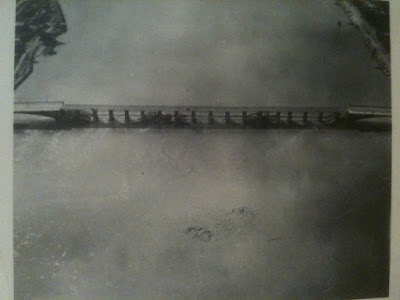 Written in pencil on the back of some of these photos are his descriptions, effusing pride, of the bridges that his battalion rebuilt ("The longest, highest, widest military built bridge in the world across the Rhine at Mainz - 17 days!").
Other pictures and their penciled descriptions give glimpses
of scenes of his life in France, Luxembourg, and Germany in 1944 and
1945.
Written in pencil on the back of some of these photos are his descriptions, effusing pride, of the bridges that his battalion rebuilt ("The longest, highest, widest military built bridge in the world across the Rhine at Mainz - 17 days!").
Other pictures and their penciled descriptions give glimpses
of scenes of his life in France, Luxembourg, and Germany in 1944 and
1945.

He took pictures of a French Military Barracks where they stayed for three weeks;
 ...a group of soldiers standing around a meal truck - "hot coffee, doughnuts and rain" (and I bet that it never tasted so good);


 German POWs ("Jerry Prisoners" and "sad sacks"), "new kraut equipment" and a half built stadium in Germany.
 There are also some pictures that need no description: GIs with French women; a leggy USO performer, bombed out train yards, damaged tanks, and crumbled buildings.

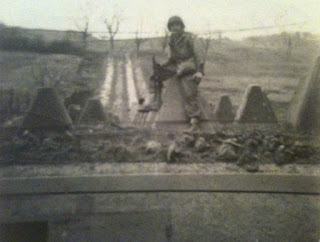
But the pictures that seem most poignant are those shots of him with friends. While many photos of random bridges and French buildings were un-labeled, the photos of him and his buddies were almost always labeled with the names of his friends: at left "McNeil, Hurston, and Marks." And on another picture: "Me and Charlie Pickens".

In June his battalion traveled to Marseille, France where he boarded the US General John Pope and sailed through the Mediterranean,
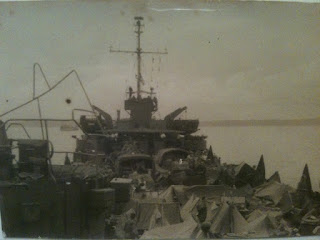
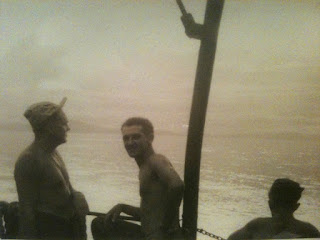
across the Atlantic,
through the Panama Canal and across the Pacific,
landing on the Marshall Islands,
and finally in Manila on August 1st.
Up to that point in time, he and his fellow soldiers must have been concerned because they thought they were on their way to join in the planned invasion of Japan.
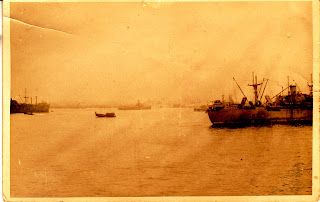
They did not know in those middle days of summer 1945, as we now do, that within days the US would drop two atom bombs on Japan, ending the war.
 So on September 15 when he arrived in Tokyo, he set foot on the soil of a Japan-surrendered.
On September 29 he boarded the USS Kenton


 He traveled to Texas where he was discharged on October 21st, and he was home in Baton Rouge by October 23, 1945. Just short of two years from when he was preparing to ship out, he arrived home, alive and "in one piece."
But his pictures, his hand written notes, documenting dates and places, and his collected postcards and other "found" photos only tell part of the story. My Mom has told me about the emotional damage he suffered: today, we would probably say that he had had post traumatic stress disorder.
I like to look at his photos and imagine the moments of camaraderie when he took those pictures with his buddies; the excitement, the scenery and the experiences of traveling across the world and two oceans.

But I also remember those things that are not captured in the photographs: the hardships shared in common by so many soldiers and what they sacrifice in service to their country.
* I assembled this timeline from a list my Grandfather had written of the dates and places where he had been in addition to the notations on the back of his photos. There may be some minor errors - but I think I got things mostly correct!

I have not served. I am one of the majority of US Americans whose life has been touched by veterans, but who has not worn the uniform. I had seriously considered joining the military in high school, but decided not to. I won't speculate how my life would now be different if I had done so. Today, I am opposed to the unnecessary use of military force. However, I acknowledge that reasonable people can disagree on what constitutes a "necessary" use of force, and I have a serious respect for those who do serve in uniform. I think that this respect comes from knowing of the soldiers among my own friends and family.
I remember as a child asking my dad if he got to shoot a gun. He replied that as a chaplain, he just had to throw the bible at the enemy. I remember that the times he was away on his two week annual trainings that I missed him - and that was only two weeks! I can't imagine the longing to see your loved ones when they are deployed and gone for months or years at a time. My dad was away when my youngest brother was born. It was fortunate timing that he was able to return for a brief time to see my mom and new baby brother in the hospital. Many soldiers do not have this chance.
I can imagine my grandfather Roger in Europe. I never knew him, he died when I was an infant. But I have had the chance to look through photos he took as well as the photos and postcards he collected as he traveled in Europe and Japan. As I have looked through, organized and done background research on these photographs, I have tried to imagine being there with him.

Thanksgiving 1943, standing in front of a house in uniform with his wife Evelyn, brother Marty (also in uniform), and sister in law Jane. He went to train at Camp Ellis in Illinois and shipped off to Europe via Camp Myles Standish in Massachusetts in early 1944.

He traveled across the English Channel to France and landed at Omaha Beach on July 24, 1944 and made the push through France that Fall.
He was in Luxembourg during the battle of the Bulge. By March 1945, they were in Germany.


There are a lot of pictures of these bridges:
bridges over the Marne and the Meuse in France;
a bridge over the Sauer river between Luxembourg and Germany; and a bridge over the Rhine at Mainz, Germany.
 Written in pencil on the back of some of these photos are his descriptions, effusing pride, of the bridges that his battalion rebuilt ("The longest, highest, widest military built bridge in the world across the Rhine at Mainz - 17 days!").
He took pictures of a French Military Barracks where they stayed for three weeks;


"Remich on the Sauer River - just resting";

and "Luxembourg near the border - real champagne - beaucoup cases!"

There are pictures of cathedrals, castles, villages,

 German POWs ("Jerry Prisoners" and "sad sacks"), "new kraut equipment" and a half built stadium in Germany.

But the pictures that seem most poignant are those shots of him with friends. While many photos of random bridges and French buildings were un-labeled, the photos of him and his buddies were almost always labeled with the names of his friends: at left "McNeil, Hurston, and Marks." And on another picture: "Me and Charlie Pickens".


By May 1945, Germany had surrendered and he was in Nurnberg.
In June his battalion traveled to Marseille, France where he boarded the US General John Pope and sailed through the Mediterranean,


across the Atlantic,
through the Panama Canal and across the Pacific,
landing on the Marshall Islands,
and finally in Manila on August 1st.
Up to that point in time, he and his fellow soldiers must have been concerned because they thought they were on their way to join in the planned invasion of Japan.

They did not know in those middle days of summer 1945, as we now do, that within days the US would drop two atom bombs on Japan, ending the war.

He spent two weeks in Japan.
 |
| Roger Hurston, with the Japanese Imperial Art Gallery in the Background |
On September 29 he boarded the USS Kenton

and sailed east to San Francisco, where he arrived on October 10.

(notice the "welcome home" banner)

But his pictures, his hand written notes, documenting dates and places, and his collected postcards and other "found" photos only tell part of the story. My Mom has told me about the emotional damage he suffered: today, we would probably say that he had had post traumatic stress disorder.


I like to look at his photos and imagine the moments of camaraderie when he took those pictures with his buddies; the excitement, the scenery and the experiences of traveling across the world and two oceans.

But I also remember those things that are not captured in the photographs: the hardships shared in common by so many soldiers and what they sacrifice in service to their country.
* I assembled this timeline from a list my Grandfather had written of the dates and places where he had been in addition to the notations on the back of his photos. There may be some minor errors - but I think I got things mostly correct!

Sunday, October 16, 2011
The car I love
I want a new car
but
I love my old car
what kind of
bad-ass car
is this that
calls for
a song of praise?
It's not my first car
not my sexiest car
not even my most bad-ass car
Just a plain
four door
economy car
four door
economy car
that gets good
gas mileage
and has a decent
stereo
A car
that has driven me
across the state
that has driven me
across the state
and
took us on our
honeymoon
and has carried me
to and from
to and from
work
and
university
In fact
that same car
carried us
to and from
the hospital
when our
oldest daughter
was
born
And
when my wife
was in the
hospital
on bed rest
with our second baby
that car
carried me
to and from
work
and university
and to the hospital
to see her
(stereo blasting
to drown out
the emotion)
And when
second baby girl
was in the
Neonatal
Intensive
Care
Unit
(alive and always improving)
that car took
me to see
her
too
Since then
it has been to
law school
and
on family vacations
and
I wonder
how long
it will
last
it will
last
I'd like to give it a proper
redneck memorial
Its very own
place
in the front yard
where I can
take the wheels off
and
put it
up on blocks
put it
up on blocks
and drain the fluids
and remove the battery
and roll down the windows
and let nature take its course
with it always there
as a reminder
of where
I've
I've
been
Subscribe to:
Posts (Atom)